Build an organization that can deliver in the core and explore new opportunities.

Build an organization that can deliver in the core and explore new opportunities.

The core has customers to serve and results to deliver. Exploration asks people to pursue opportunities whose customers, economics or technical requirements may still be uncertain. Leaders need to create conditions in which both kinds of work can succeed.

The core has customers to serve and results to deliver. Exploration asks people to pursue opportunities whose customers, economics or technical requirements may still be uncertain. Leaders need to create conditions in which both kinds of work can succeed.

The new business needs autonomy and deliberate connections to the core.

The new business needs autonomy and deliberate connections to the core.

Senior leaders hold responsibility for both businesses. The explore unit needs room to develop its own capabilities, measures and investment discipline, while retaining access to assets the core can provide. Separation alone does not settle those commitments.
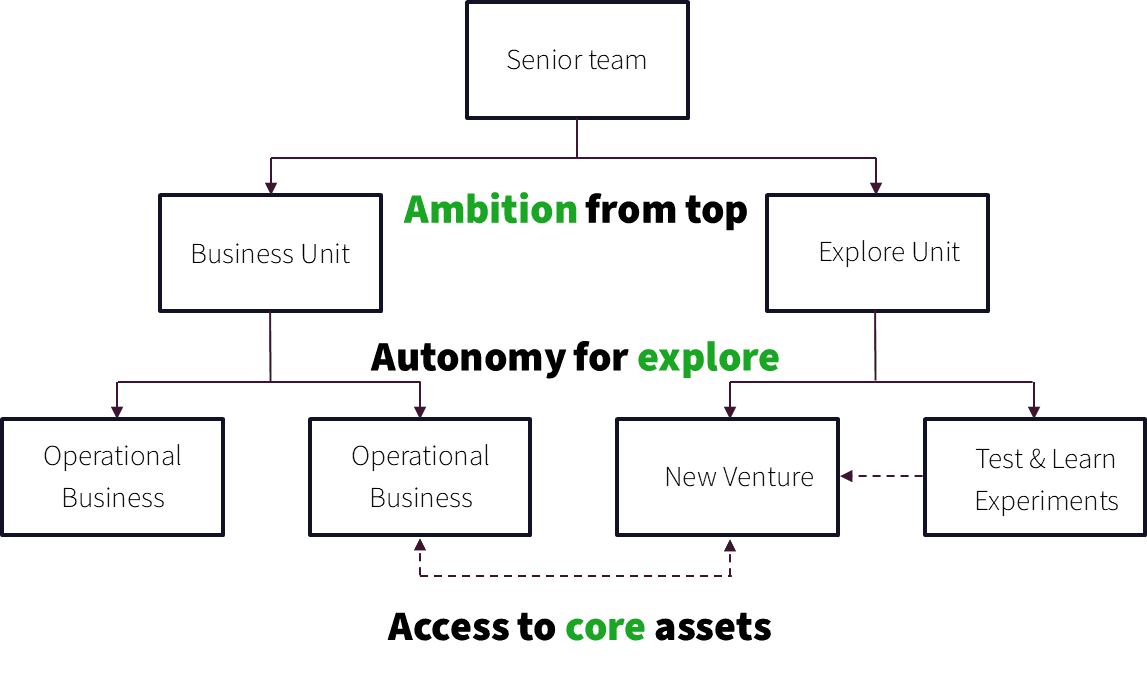
From Change Logic’s Key Frameworks, January 2025, drawing on the work of Michael Tushman and Charles O’Reilly.

Examine how the opportunity differs from the work you already do.

Examine how the opportunity differs from the work you already do.

A new opportunity may involve different customers, unfamiliar technology or a different business model. Consider which capabilities transfer from the core and which must be developed. An offering can be familiar in the market and still be new to your organization.

A new opportunity may involve different customers, unfamiliar technology or a different business model. Consider which capabilities transfer from the core and which must be developed. An offering can be familiar in the market and still be new to your organization.

The extent of the organizational change depends on those differences. Growth alone does not tell you whether the existing organization can support the opportunity. Examine what the work requires before deciding how it should be organized.

The extent of the organizational change depends on those differences. Growth alone does not tell you whether the existing organization can support the opportunity. Examine what the work requires before deciding how it should be organized.

Measures and incentives need to reflect what the work requires.

Measures and incentives need to reflect what the work requires.

In the core, leaders can often judge performance against known customers, costs and delivery expectations. Early exploration requires evidence about assumptions that remain unresolved. Applying the core’s measures too soon can encourage a team to pursue familiar revenue while avoiding the uncertainty the opportunity requires it to investigate.

In the core, leaders can often judge performance against known customers, costs and delivery expectations. Early exploration requires evidence about assumptions that remain unresolved. Applying the core’s measures too soon can encourage a team to pursue familiar revenue while avoiding the uncertainty the opportunity requires it to investigate.

Decide what progress should mean at the current stage and how you will recognize it. As evidence develops, revise the commitments and expectations. Teams need accountability for the quality of their work without being encouraged to present uncertainty as certainty.

Decide what progress should mean at the current stage and how you will recognize it. As evidence develops, revise the commitments and expectations. Teams need accountability for the quality of their work without being encouraged to present uncertainty as certainty.

Decide what needs its own organization and what must remain connected.

Decide what needs its own organization and what must remain connected.

A new business may require different skills, working practices, incentives and leadership. It may also depend on the core for customers, expertise, distribution or funding. Separation should protect the differences that matter while preserving access to those strengths.

A new business may require different skills, working practices, incentives and leadership. It may also depend on the core for customers, expertise, distribution or funding. Separation should protect the differences that matter while preserving access to those strengths.

Make the dependencies explicit. If a shared sales team is expected to introduce a new offering, examine whether its targets, time and incentives support that commitment. An organizational boundary will not resolve conflicting demands on its own.

Make the dependencies explicit. If a shared sales team is expected to introduce a new offering, examine whether its targets, time and incentives support that commitment. An organizational boundary will not resolve conflicting demands on its own.

Senior leaders have to resolve the demands on both businesses.

Senior leaders have to resolve the demands on both businesses.

Resources committed to exploration are resources the core may also need. Leaders must agree why the opportunity matters, which commitments they will protect and what evidence would justify further investment, a different approach or stopping.

Resources committed to exploration are resources the core may also need. Leaders must agree why the opportunity matters, which commitments they will protect and what evidence would justify further investment, a different approach or stopping.

Those choices need to be reflected in how the senior team works and is evaluated. Leaving each business to defend its own priorities can repeatedly favor the more immediate and measurable return.

Those choices need to be reflected in how the senior team works and is evaluated. Leaving each business to defend its own priorities can repeatedly favor the more immediate and measurable return.

UNIQA built Mavie to pursue growth beyond its insurance business.

UNIQA built Mavie to pursue growth beyond its insurance business.

UNIQA’s leadership set an ambition to build a substantial healthcare business. Change Logic worked with the CEO and senior team over several years to develop the strategic ambition, define where to explore and establish the conditions for the new business.

The work included the UNIQA 3.0 Strategy Manifesto, followed by customer discovery and experimentation. The innovation team ran more than 30 experiments across seven new business areas during the first year.

As UNIQA established Mavie, CL helped develop its structure, budget, governance, talent strategy and innovation methods. Twenty team members were trained and certified in the methods during the first year. This built capability within the team responsible for developing the business.

These engagement details are drawn from Change Logic’s 2025 UNIQA–Mavie case study.

We help leaders put these choices into practice.

We help leaders put these choices into practice.

Change Logic helps leadership teams define the organizational requirements of the core and the new business, decide where to separate and connect them, and establish the commitments needed from both. Our practitioners work with your teams as they test the opportunity and develop the capabilities to carry it forward.

Change Logic helps leadership teams define the organizational requirements of the core and the new business, decide where to separate and connect them, and establish the commitments needed from both. Our practitioners work with your teams as they test the opportunity and develop the capabilities to carry it forward.